
And Then There Were None
Sterling Playmakers
Teen reviewer: S. Bowles
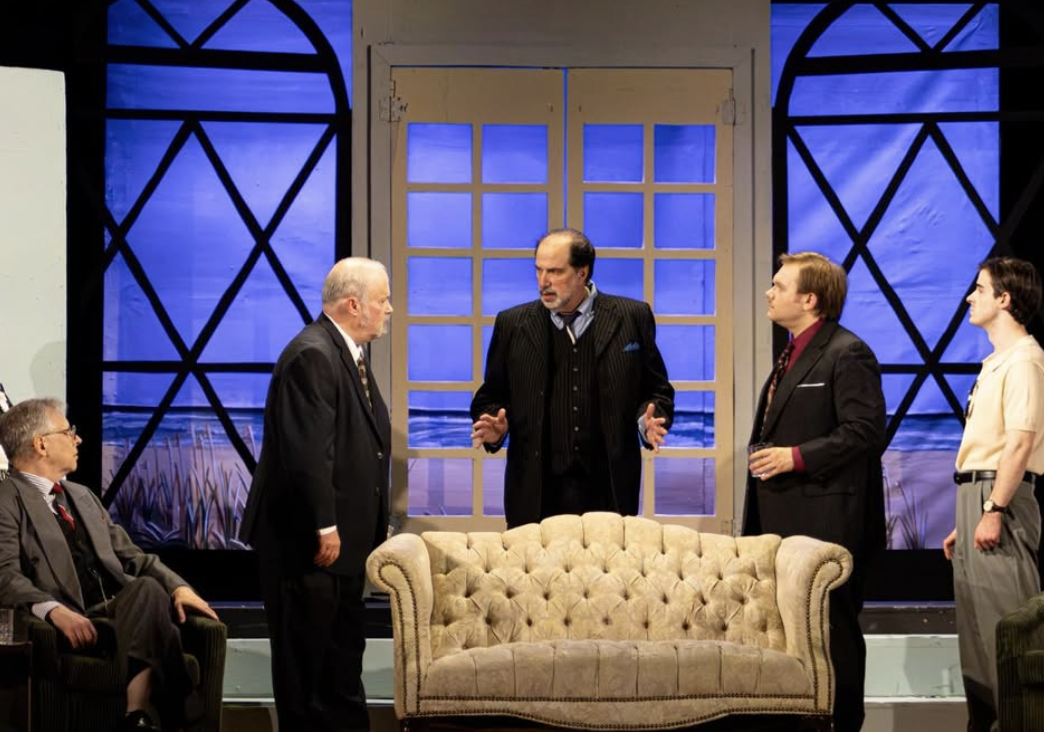
Photo credit: Tyrus Sanders
Ten little soldier boys went out to dine…
In Sterling Playmakers’ production of And Then There Were None, the staged adaptation of Agatha Christie’s novel, mystery knocked at every door. As the cast was slowly cut down, the drama built and built until–well, you’ll have to see for yourself.
Pay attention! You may not know what is important…until it is too late.
Rundown
The renowned English author Agatha Christie wrote the mystery novel And Then There Were None in 1939. While she had been writing and publishing books for almost two decades at this point, this book in particular became a bestseller; it still stands as one of the most sold books of all time. Its first American edition was published under the name we know it by now, and today, all around the world, it’s acknowledged as a famed, utterly macabre thriller.
Agatha Christie opted to write the original staged play, though she changed the ending so as to not drive theatre-goers away. This play was first put onto stage in 1943, and with the different ending came a more palatable, and overall sweeter resolution than that of the book, in which everyone simply dies–of course, that is a bit more difficult to translate to a play where most of the context and setup is given through the dialogue.
In contrast to the original novel, the stage adaptation was not simply a mystery thriller, but instead, more of a black comedy. This helps the production to add context in clever quips, rather than forcing the actors to just drivel on in order to provide exposition. In addition to this helping the flow of the writing, it also helps to build the relationships between the characters.
After a brief introduction by a mysterious narrator, the play begins with the servants of an island’s lone house setting up for a gathering, remarking on their never having met the supposed owner of the house: one U.N. Owen. As the guests slowly arrive, they all begin to put the pieces together to realize that their host is, in fact, Unknown. Fear only grows as a record plays from the gramophone, accusing each and every guest, and servant, of a murder they had committed in their past. With everyone shaken to their core, secrets start to come out of the woodwork, and the guest list starts to get whittled down–the order strangely in accordance with a nursery rhyme they find on the wall.
With each person consecutively falling to the fates of the rhyme’s “soldier boys,” it can’t be known who will die next. Abandoned on the island, paranoia escalates; after all, anyone could be the next victim…
This Production
The scene adopted a classic look with the interior of the house open to the audience, bookshelves on either side, and French doors in the center of the stage, leading out to a background of a beach scene. On either side of the set, there were doors leading backstage, which the characters frequently entered and exited from. Because of the way this production was set up—with a wide, flat set that felt like it stretched on through a large room, though the stage itself wasn’t particularly deep—there was a sense of claustrophobia, which created an interesting contrast against the supposedly open air of the beach house.
A notable aspect of this show was the lighting, with inspiration from the film noir era being very apparent. There were a couple of tracking spotlights, which, well, took the spotlight in their own regard! They made quite an impact on the overall show, transforming the play into a drama-rich story. With the darkening of the stage and a single lit face, the feeling of a cinematic zoom-in was created. After all, what is more accurate to the film noir era than a murder mystery? And with Cassidy Cook-Lapierre’s directing, the mix of drama between stage and screen worked to create an interesting aura for this straight play.
While every performance added to the mystery that this story holds, there were a few standouts. Vera, played by Isabel Ochoa, served this production’s heightened direction very well. With her cautious body language and well-maintained poise, we were left wondering if she was so scared because she was guilty, or because she was orchestrating the entire plan. Playing wonderfully alongside her, Sheila Lamb’s portrayal of Emily Brent was wry, snippy, and just understated enough to make an impression on the audience. Her and Vera’s battle for piety built tension just enough that we were suspicious of her intentions. Nathan McGraw’s Philip Lombard was another highlight, smoothly switching between the roles of the charming courtier and the braggart soldier. When his honesty and vulnerability came out, it contrasted well with his deceptive unlikability. And, opening the show, Scotii Drumgoole did a fantastic job of setting the scene for the slow build into chaos.
A quick shout out to the costuming team and the hair and makeup team: every part of this production fit perfectly with the setting, and that was especially notable with every single actor’s appearance. Vera Claythorne’s soft curls showed her potential innocence, Anthony Marston’s slicked back hair worked with his petulant nature, and Emily Brent’s tight updo just further imbued her character’s strict personality.
One moment that was particularly well done was when the gramophone started to play the indictments of each character. With the spotlights landing on every new guilty party, there was more drama–who was really to blame? Who had played this trick? The film noir inspiration was very noticeable in this scene, and it was very well done.
And after that? As the actions within the rhyme were carried out, fear could only grow. We start off with ten; with a choke, nine; dozing off, eight; in the background, seven; in a swing, six; with a jab, five; tying up loose ends, four; doubtfully, three; tragic and immediate, two; and in a moment of tension, one. But exactly how everything plays out? Well, that’s where the mystery lies.
Who is it for?
This show is for anyone looking for a delightfully dangerous time at the theater. Whether there were ten onstage or one, the drama was constant. Being based off of one of the most best selling stories of all time, this production is driven and will have you wondering: who’s next? Because of the way the show plays out, it’s imperative to be paying close attention to the details. If you’re the type of person who wants to find every bit and piece that leads to an indubitably tumultuous ending, this is the show for you.
Being an older show, it doesn’t move incredibly quickly, but it uses all the time it has to carefully set up every single aspect of the plot. There are a couple moments of quickly changing lights, though there wasn’t really a strong presence of intense flashing lights. Luckily, because this show leans into the high contrast of older movies, the focus is directed well, and if you normally have some trouble locating where the action is on stage, that won’t be a problem for this show.
I’d put the age cutoff at around 13+, given the darker subject material and the pace of the show. There aren’t any raunchy moments, but there is a whole lot of death, so one should take that into their knowledge of what watching the show entails.
This run is almost over, but there’s still one chance to see this show! To find more information on this show and buy tickets, visit https://www.sterlingplaymakers.org/and-then-there-were-none.