
Into the Woods
St. Mark’s Players
Teen reviewer: E. Forrest
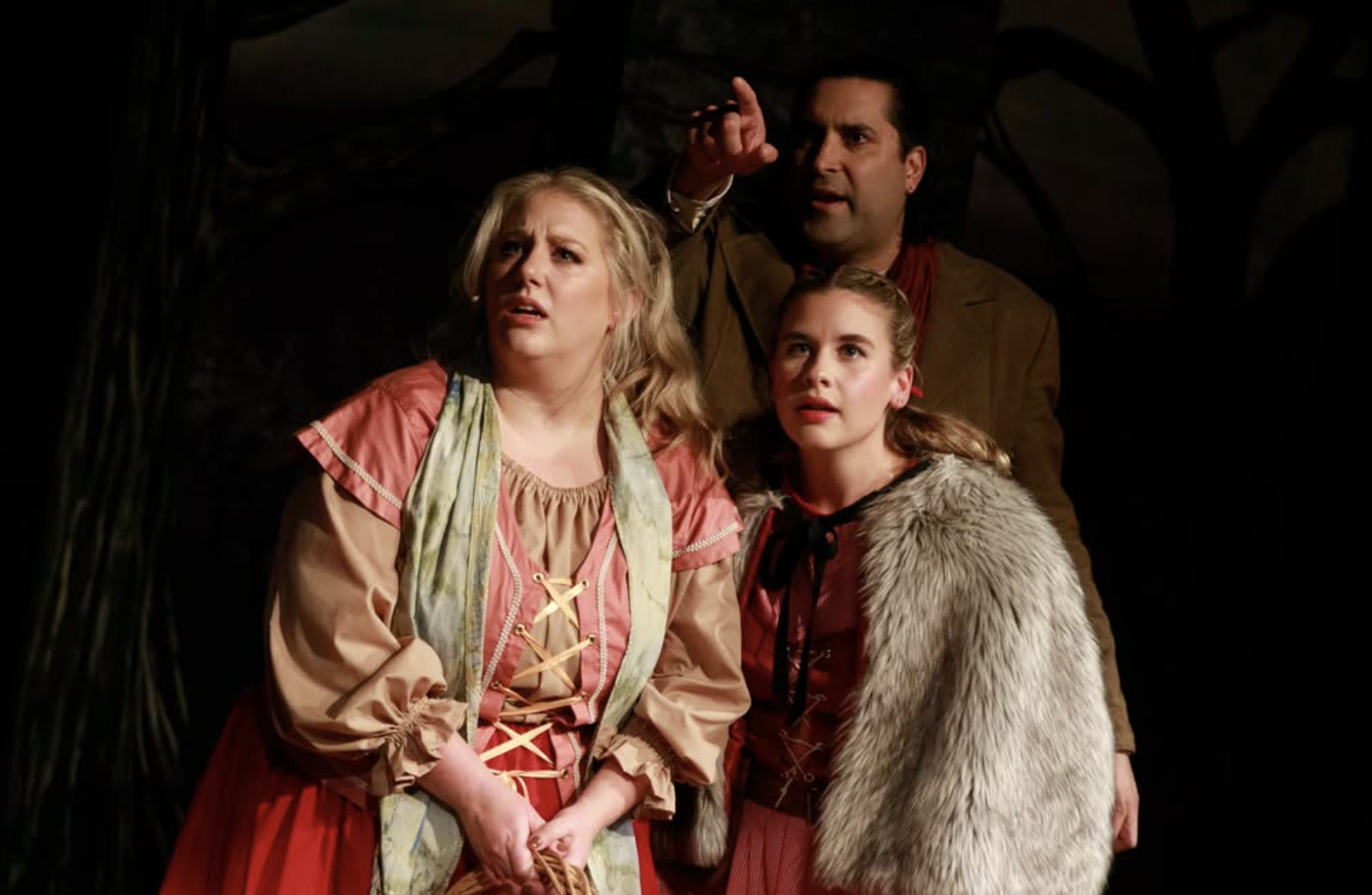
Photo credit: @markalanandre on Instagram
Welcome one and all to a zany land of golden slippers, crimson capes, and not-so-happily ever afters!
With charm and heart in equal measure, the St. Mark’s Players’ production of Into the Woods dazzled, spinning an often-told tale through enrapturing performances, immersive technical components, and a crystal-clear artistic vision. All in all, it was a show that proved to be all you could wish for--beyond magic beans and golden eggs, that is.
Background
With a book and score by James Lapine and Stephen Sondheim respectively, Into the Woods opened on Broadway at the Martin Beck Theatre in 1987. The show released to critical and commercial success despite fierce competition from Phantom of the Opera, which would make its debut just a few months thereafter, and arguably overshadow Sondheim’s fairy tale farce for much of its run. The true success of Into the Woods, however, has outlasted either show’s complete Broadway tenure, with the show having established itself over decades as perhaps Sondheim’s most defining work. A story woven from various iconic fairytales including “Little Red Riding Hood,” “Jack and the Beanstalk,” and “Cinderella,” Into the Woods’ first act largely serves as a lighthearted, almost jaunty satire of classic children’s stories. It primarily follows a baker and his wife, who must collect four items to lift a curse that prevents them from bearing children. In the woods, these fairytale characters’ stories tangle and intertwine, culminating in an ostensibly perfect, “happily ever after” for them all. It’s in act two then that the curtain is pulled back, returning the audience to the still unsatisfied principal cast of characters as they reckon with their past choices, precipitating deadly consequences. Endlessly entertaining yet heart-rending at times, Into the Woods tells a tale that breaks down what it means to grow up, and deconstructs “happily ever after” in the context of the choices that led each character there, and the choices they still have yet to make.
Performances
Under the fantastic direction of Sabrina McAllister, the St. Mark’s Players astounded in their sheer level of talent, with each actor bringing a profoundly fresh yet cohesive performance. The veritable heart and soul of this production of Into the Woods, Gerardo Mijares-Shafai delivered a multifaceted, phenomenally-executed take on the Baker, whose story essentially provides the throughline upon which the rest of the musical is built. Amplified by expressive vocal dynamics and subtle but intentional facial affectations, Mijares-Shafai’s comedic deliveries still managed to remain grounded throughout, not once teetering off into the realm of the outlandish while consistently exploiting the humor in nearly every line to perfection. However, in act two, Mijares-Sharfai was able to seamlessly portray The Baker’s grief and feelings of hopelessness while never losing sight of his original characterization, presenting a fully realized and deeply moving journey throughout the production. This, in addition to mighty displays of vocals throughout--most exemplified in the tear-jerker “No More”--combined to form a hilarious, deeply moving performance.
Opposite Mijares-Sharfai was Betsy Scarisbrick, who masterfully captured the Baker’s Wife with a sense of comedy and simultaneous intensity (when needed) that proved both endearing and impressive. Scarisbrick brought a bubbly, loveable aspect to her scenes that played greatly off of each and every scene partner, augmenting comedic moments yet never getting in the way of her pragmatic arguments with the Baker, or her introspective epiphany in act two. Scarisbrick’s vocals, too, soared from delicate and beautiful to rich and powerful throughout her every number, perfectly complimenting Scarisbrick’s expressive characterization.
Technical Elements
Also remarkable were Jack, played by Brett Wood, and Cinderella, played by Marissa Michaels. With an ever present childlike glint in his eyes, sporadic but lovable characterization, and a gorgeous vibrato to boot, Wood effectively portrayed Jack’s youthful side, which made the character’s difficult transition to maturity in act two all the more compelling. Finally, Marissa Michaels’ enrapturing performance as Cinderella was one of hopeful indecision, with expressive facial expressions and a beautiful tone that shone through in “No One is Alone” and “On the Steps of the Palace.”
Situated cozily within St. Mark’s Episcopal Church, this production of Into the Woods took full advantage of their location, turning what could have been a limiting venue into one of the show’s greatest strengths: its intimate, immersive atmosphere. Kim Leone’s minimalist set was a triumph, and stood in perfect coherence with the production as a whole. Primarily utilizing three periaktoi-like structures (rotating pillars with various artworks on all sides) to set each scene, the production cleverly weaved actors in and out of the set as well as through the audience, making the space feel lived in and vast--perfectly befitting the show’s dark and twisting titular “woods.” David Chase’s lighting design also added various levels of depth, portraying the inner thoughts of characters during prominent solos with overwhelming washes of color. Additionally captivating were the sparing, intentional uses of darkness throughout, once again adding an ambience that felt as if one had truly been dropped into the pages of a kooky fairytale story. Finally, the costume design by Joan Lawrence proved to be the finishing touch on St. Marks’ tremendous audiovision feast with complete larger-than-life gowns, multicolored royal uniforms, and flowing robes. Most remarkable was Cinderella’s dress: a simple yet timelessly elegant piece with golden floral patterns complimented by dark, elegant undertones.
Who is it for?
Despite Into the Woods’ seemingly daunting runtime (clocking in at roughly 3 hours including a 15 minute intermission), this production flew by, energized by larger than life performances, great cast chemistry, and immersive technical elements. There’s a little something for everyone; whether you’re in the mood for a hilarious comedic jaunt or a more mellow, reflective piece, St. Marks’ Into the Woods has it all.
As far as age ranges go, this production can plausibly be seen and enjoyed by anyone, with some caveats being that there are a few implied deaths during the second act, as well as suggestions of infidelity. It’s important to note that act two admittedly does get fairly heavy and might not be entirely appropriate for little ones going into it expecting a fluffy, fairy tale story. For kids 10 and up, though, there shouldn’t be too many problems as far as the show’s content goes.
St. Mark’s Players’ Into the Woods was a joyful, moving reflection on growing up and how the choices we make lead us to our ultimate destinations. Taking full advantage of Sondheim’s iconic, beautiful score and Lapine’s brilliant writing, this rendition was as poignant as it was enchanting.
Into the Woods runs at St. Mark’s Episcopal Church until October 17th. Visit https://www.stmarksplayers.org/ for tickets and more information.