
Into the Woods
Workhouse Performing Arts
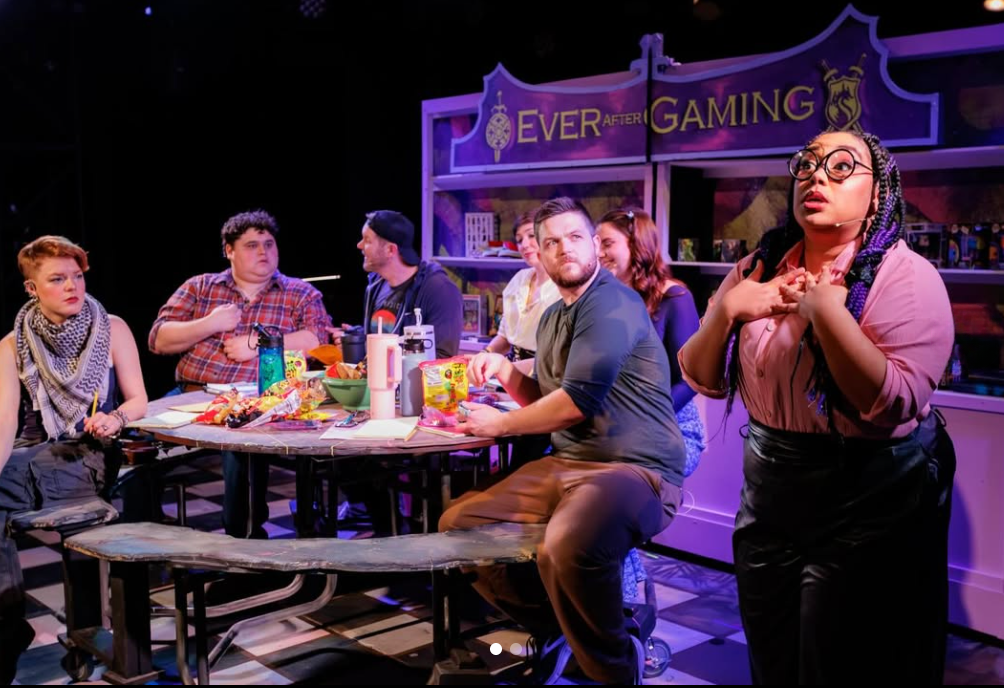
Photo Credits: @zoophoriaphotography on Instagram
Someone grab a d20 and roll for a sanity check!
That’s right: in Workhouse Performing Arts’s latest production of Into the Woods, the company transported Sondheim’s beloved characters from the pages of a storybook to the realm of a Dungeons and Dragons campaign. With whimsical props, an enchanting set, and an incredible on-stage band, it’s clear Jackie Madejski’s vision for this production is a game of epic proportions.
Shows like these make me giddy about writing reviews that cater to a teenage audience. I feel like this iteration of Into the Woods was absolutely geared toward young (and young-at-heart) generations--not in a way that dumbed down the material, but that presented it under a very different lens. In fact, it made me re-examine some of the show's key facets as a whole.
Grab a pencil and some Sour Patch Watermelons; it’s time for a quest!
(No, not like in Percy Jackson. Different show).
Into the Woods… with Dice?
I sincerely hope you’re familiar with Into the Woods, or this review will make zero sense. Want a quick briefing? Check out this review of Oakton High School’s Spring 2025 production .
Honestly, the same necessity applies when it comes to viewing the actual show. I’d at least skim the Disney film before attending, to get a better idea of how the script was originally staged. (It hurts me to promote the Disney film, as I am a passionate advocate against it, but who would I be to promote bootlegs? Wink wink).
At approximately 10 minutes until curtain, actors began slowly trickling in through the audience door. Some were exuberant, some reserved, and some utterly confused, but they all found themselves drawn to the stage’s central round table. Teeming with snacks, board games, and loads of dice, Tim Grant’s clever set practically begged for a food-filled, friendly hangout.
Plus, Audrey Mille’s costuming made a fun game out of guessing which actor would play each character once they walked in. In a “disney-bound” type of approach, each character’s street clothes were arranged into outfits that embodied the show’s fantastical roles. Ariel Friendly wore round glasses, purple braids, and leather pants, while Alan Gutierrez-Urista donned a plaid shirt, brown belt, and jeans; foreshadowing the soon-to-be Witch and Jack, respectively.
I say “soon-to-be” because each character was assigned their roles as part of the Dungeons and Dragons campaign. Here’s where we had a case of role-ception: each actor was playing a person in the show, who was also playing a character in the campaign. Thus, instead of confidently stating their lifelong wishes in “Prologue,” the performers pored over the character sheet they had just been given, rushing to decipher their in-game character’s motivations.
So what exactly were these motivations, and how did each actor bring them to life?
Performances
As any player would know, no D&D game exists without its presiding Dungeon Master. Tasked with the role of spinning the narrative for players to interact with, its importance can’t be understated--luckily for us, Mel Gumina did an excellent job setting the tone for the show. Though officially playing the role of The Narrator, Gumina took on numerous characters throughout the production: greedy Wolf, vicious Grandma, aching Prince, and Cinderella’s birds, to name a few. Gumina completely transformed her physicality in each new circumstance, and her enthusiasm remained at an all-time high.
Often at odds with Gumina was Ariel Friendly in the role of The Witch. (PSA: if it hasn’t been obvious from my other reviews, I heart Ariel Friendly). While the opening number was filled with fast-paced dialogue and rapid energy from most of the actors, Friendly had the audience in the palm of her hand with her sly grin and still presence. It was extremely evident she knew all the ins and outs of her character--from her sass during “Prologue,” to the heartache of “Witch’s Lament,” to the unquestionable power of “Last Midnight.” Essentially, it was a fan-caster’s dream come true.
Honestly, this entire show felt like a fan-cast. Michael McGovern, another DMV favorite, was excellent in the role of The Baker. Though his character was less invested in the D&D campaign at first, McGovern’s rendition of “No More” was incredibly rooted in the story’s emotional rollercoaster. Confession: I almost always skip this song, but McGovern’s velvet-smooth vocals made me wish there was an extra verse.
Cade Mac Aodhagain stepped into the shoes of The Baker’s Wife, and approached the role with plenty of its trademark sass. Mac Aodhagain’s performance of “Moments in the Woods” was certainly a powerful one; it was easy to trace each thought running through their mind as the piece came to its life-altering conclusion.
Hannah Siegel brought her own to the role of Cinderella, in a delightful interpretation that gave the princess a quirkier side. Her songbird vocals shone in “On the Steps of the Palace,” coupled with a personality that brought the princess down to earth.
It was almost akin to Anna from Frozen--while certainly bright-eyed and naive, she didn’t shy away from throwing a girlish fit or two while running from the prince.
Alan Gutierrez-Urista and Andrew Edwards took on two of the show’s most fiery roles: Jack and Little Red. The former was initially hesitant to misstep in the game--having to write facts on his hands to remember them--but soon embraced everything his new world had to offer with a triumphant “Giants in the Sky.” On the other hand, Edwards’s character was clearly there for the Sour Patch Kids. While I was initially skeptical of the role’s non-traditional casting, I soon realized the brilliance in its potential to heighten Little Red’s comedic moments. Edwards’s performance was just that: hilarious. With an excellent balance between dry delivery and earth-shattering temper tantrums, his Little Red won me over whole-heartedly.
Finally, this production was unique in its method of covering all the show’s other characters. Typical of D&D campaigns (or video games, for that matter) are NPCs: non-playable characters that play a key role in the story, but who aren’t controlled by the game’s players. Shelby Young and Melynda Burdette filled these shoes, bringing a dynamic set of characters to life who impressively transformed in the blink of an eye.
Who is it For?
This show is, first and foremost, for geeks of all ages and all kinds: theatre, D&D, whatever it may be. I personally enjoyed this show because I thought I knew Into the Woods like the back of my hand, and walked out of Workhouse’s doors with a whole new set of questions spinning in my brain.
What happens when a show about decisions is placed under the control of a twenty-sided die? Does this lack of autonomy undermine the show’s central theme, or does it represent fate: the lack of control we have to face in the real world? These questions aren’t rhetorical, by the way--buy tickets and report back to me with your thoughts.
It’s a show that promotes discussion. AKA, my favorite type of production, and one we need more of.
Workhouse Performing Arts’s Into the Woods runs until January 25th, but tickets are selling fast! Truly, Workhouse never misses, so keep your eyes peeled for the rest of their season.
For tickets and more information, visit https://www.workhousearts.org/calendar/into-the-woods.