
Les Misérables: School Edition
Westfield Summer Stage
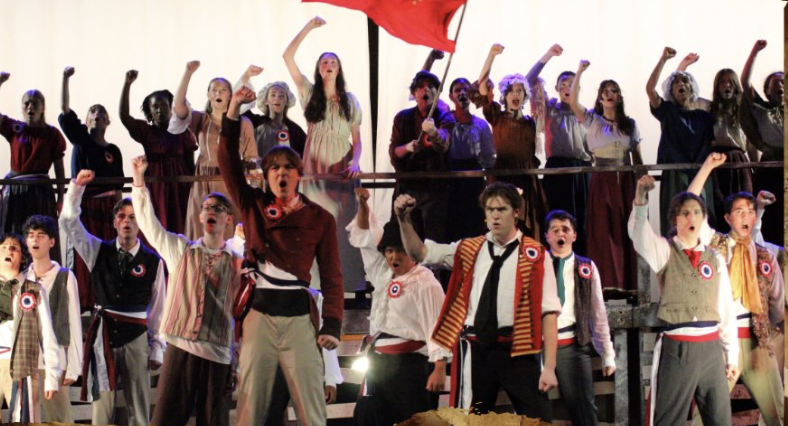
Photo credits: @mcnerney_photography on Instagram
Vive La France!
More than a few students cried this sentiment in Westfield Summer Stage’s recent production of Les Misérables: a tragic tour de force through the June Rebellion of 19th century France. Vengeful students, soaring harmonies, and a massive flag… need I say more? It’s iconic. It’s beloved. It’s Les Mis.
But more than any of those things, Les Misérables is a feat. The show is almost 3 straight hours of sung material, almost all of which is vocally demanding and emotionally heavy in nature. The cast, crew, and orchestra from Westfield Summer Stage took to this task with vigor, and each student delivered a dedicated performance that impressively navigated the difficult material.
Enough jibber jabber. Let’s get into the meat and potatoes of Les Mis, one of the world’s most iconic and beloved musicals.
Les Misérables
Les Misérables was first published as a series of volumes in 1862. French author Victor Hugo took inspiration from the political tumult that surrounded him, and wrote this collection over a 30 year-period. Fun fact, Hugo also wrote The Hunchback of Notre Dame, which went on to inspire its own series of iconic musical works!
There’s a key difference, though: while Hunchback was written as one volume (which contained 11 “books” and 60 chapters), Les Mis was a series of five volumes, altogether containing 48 “books” and 365 chapters.
Somehow, French composing-writing duo Claude-Michel Schönberg and Alain Boublil compressed Hugo’s expansive material into a 3 hour mega-musical. They first released Les Mis as a concept album in 1980, before attempting to stage it in Paris. So, yes, the original show was written in French!
It also closed after a three-month run. Woof.
Luckily, British producer Cameron Mackintosh got a copy of the concept album, and teamed up with lyricist Herbert Kretzmer to create an English adaptation. Before long, Les Mis took the West End by storm, opened on Broadway, and became an international phenomenon. Well, everywhere except in its birth nation, clearly.
Today, Les Mis has become the longest-running musical in the West End, had a plethora of successful national tours, and inspired a star-studded movie adaptation. The school edition of Les Mis eventually released in 2001, and--for a long time--was the only available avenue for local companies to perform the material. While certain songs were trimmed for length (including most of the complex, counterpoint duet “The Confrontation”), the show’s core material remained the same… war, bloodshed, dancing prostitutes, and all.
Now, this was fantastic news for high schoolers. Anyone over the age of 19, though, was out of luck. If you’re like me, and are now utterly depressed because you just graduated high school and desperately want to be in a production of Les Mis… don’t fret quite yet.
As of less than a week ago, MTI has made the full edition of Les Mis available to license! In fact, a couple of DMV community theaters have already announced it’ll be joining their next season, so keep your eyes peeled for the all-ages audition notices next summer.
Until then, let’s celebrate Westfield Summer Stage’s rendition of Les Misérables: School Edition!
Technical Elements
I’ve never once been to France, but I sure felt patriotic walking into the Westfield auditorium.
For starters, thanks to set designer Molly Harper, a wooden platform engulfed the stage, which was set against the backdrop of the French flag. Kudos to lighting designer Mary Clare Bernier for lining the proscenium with panels of light, which extended the colors of the flag further outward, and immersed the audience in all aspects of the story. Typography projected onto the cyc also helped distinguish the show’s shifting locations and time periods, which I very much appreciated.
Becky Anderson’s costumes further established the historical period, dressing performers as if they’d stepped out of a 19th century painting. They also illustrated class differences: while Javert was buttoned up in a military jacket and Cosette donned a frilly gown, slaves and beggars were subject to loose clothing and dirt-stained faces. Emily Miller, head of hair and makeup, heightened this difference by topping the Thenardiers with larger-than-life wigs; one of Madame Thenardiér wigs was so tall, she was able to “open” the side of it like a door to steal sweets!
In a sung-through show like Les Mis, sound is incredibly important. Luckily, Jonathan Short, Narayana Sundarrajan, and Sean Salas nailed it, and I’m happy to report that everything was well mixed across the cast and orchestra! The pit itself was outstanding, and navigated this beast of a score with admirable ease. So many of the numbers in Les Mis require pinpoint-accurate timing from both cast and orchestra; thanks to music directors Jon Blank and CJ Redden-Liotta, the orchestra expertly adapted to the cast onstage, and truly became the driving force of the production. In short, the hardworking (and often unsung!) pit deserves all my roses.
Performances
When it came to the cast, each performer was bursting with passion and dedication. Tony Hillary truly carried the backbone of the show in the role of Jean Valjean, charitable ex-convict and protective father. He delivered a tear-jerking rendition of “Bring Him Home,” and soared into a crystal-clear falsetto in one of the show’s most tender moments; it earned him some of the biggest applause of the night. Valjean’s nemesis, Loic Razanakoto delivered a ruthless performance in the role of Inspector Javert. He positively spat at Hillary during their confrontations, and brilliantly illustrated his character’s internal conflict.
Heading the revolution efforts was Max Gerstenberg as Enjolras, who displayed fiery devotion to the cause. With booming vocals and impeccable intonation, Gersetenberg rightfully rallied the students of the ABC cafe to join the fight; among them being Marius, played by Lucas Schnotala. Schnotala truly embodied the part of the lovestruck tenor, instantly taken aback when he caught a glimpse of Cosette for the first time. All throughout, Marius stopped at no cost to obtain her love… and left me thinking that the male populace of today ought to be taking notes.
Isabella Lacson provided the perfect lovey-dovey, doe-eyed match to Schnotala’s Marius. With songbird vocals that effortlessly soared (that C6 at the end of “Heart Full of Love (Reprise)” is no joke!), she practically floated across the stage. Meanwhile, Sienna Nguyen brought the scrappy, spirited Eponine to life. Nguyen expressed Eponine’s longing for Marius with wounded frustration, and deftly navigated tricky sections of the score with an impressive mixed belt. Rebecca Zanotti demonstrated a similarly heartbreaking arc as Fantine, sacrificing her own life for the sake of her daughter’s and effectively setting up the tragedy to follow.
As the Thénardiers--corrupt, abusive parents to Eponine and Cosette--Nikko Luspo and Kiera McCrea playfully roused the audience in “Master of the House.” Luspo perfectly encapsulated the slimy, greedy nature of Thénardier, while McCrea transformed into his kooky, fed-up wife; a duo that made for a slew of comedic moments and mischievous endeavors.
Finally, I have to shout out Luke Schmidt’s heartwarming performance as Gavroche, the young, energetic street urchin. His every note was remarkably clear and crisp, coupled with an adorably innocent, fist-pumping dedication to the revolution. It was impossible not to root for Schmidt, which made Gavroche’s tragic end all the more heartbreaking.
The ensemble, which consisted of middle and high school students from across the county, crafted a captivating ensemble. Whether they tirelessly slaved away in a factory or bravely fought in the rebellion, each student’s ferocity really illustrated the French working class’s determination to strive for a better tomorrow.
Who is it for?
Like I’ve already harped on, Les Misérables is absolutely one of the most emotionally-ridden, profound musicals of all time. The score is beautiful and peppered with leitmotifs, and the characters are wonderfully complex. Director Christine Maxted made sure to remind us through her production that no matter how tragic the circumstance, there will always be a ray of hope. It’s a message that remains startlingly relevant centuries later.
The show certainly isn’t a short one, clocking in at around 3 hours of runtime (including a 15-minute intermission), but an epic of this scale deserves the time to truly be fleshed out. Again… five volumes of Victor Hugo content doesn’t come free.
From a content perspective, Les Mis is pretty heavy--even considering the fact Westfield Summer Stage performed the school edition of the show. Like I mentioned, the production contained depictions of war, death, suicide, child abuse, and prostitution. I’d personally recommend it for ages 10 and up. Still, considering the entire show is sung, most of this content would likely go over younger children’s heads.
While Les Mis has since closed, Westfield Summer Stage performs a musical (you guessed it!) every summer, so be sure to keep an eye on their website (https://www.westfieldtheatre.com) and instagram page (@westfieldtheatre) for more information throughout the school year.