
Merrily We Roll Along
Signature Theatre
Teen reviewer: S. Bowles
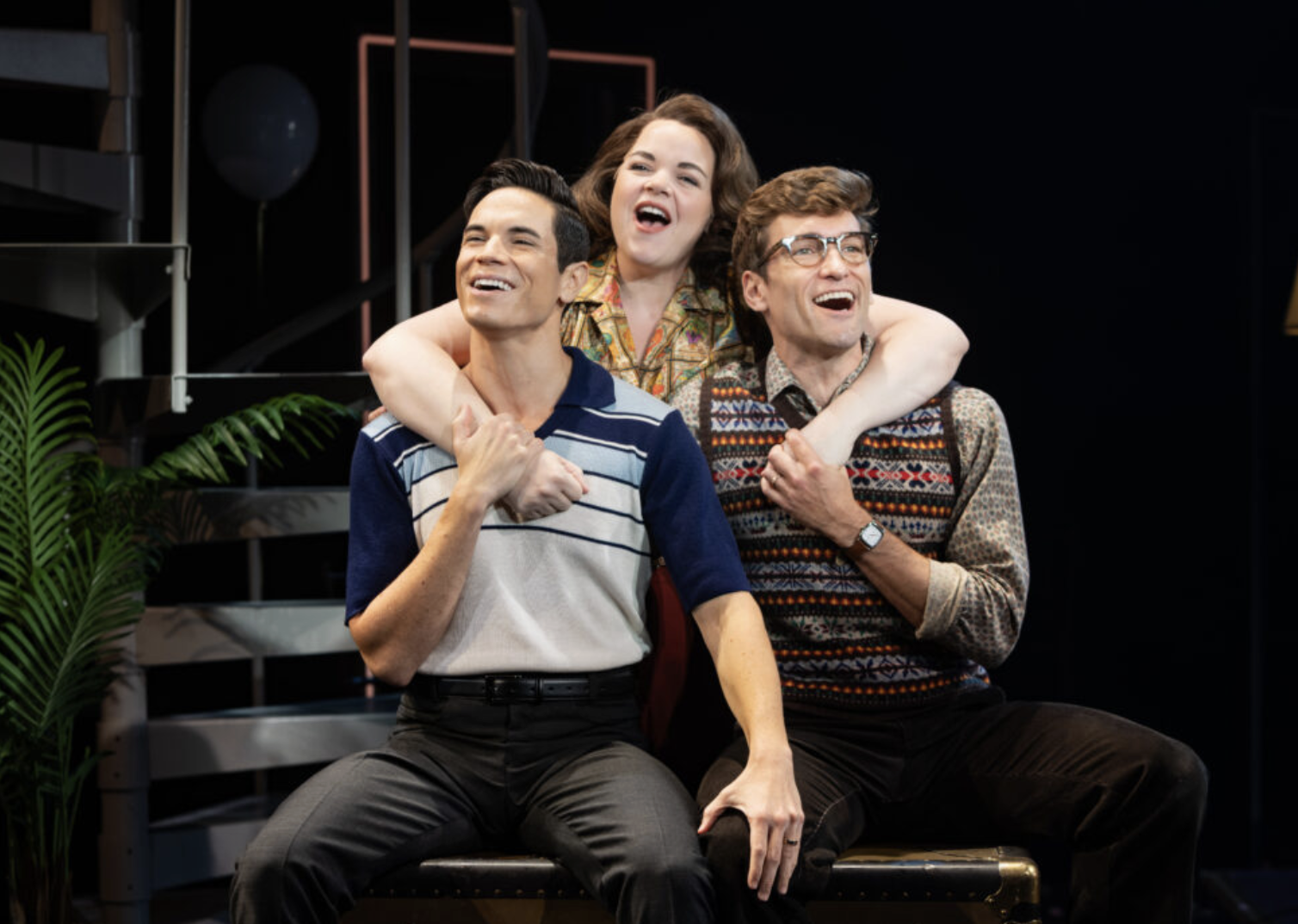
Photo credit: Christopher Mueller
Have you ever wished you could look back through your life, witness all the choices you’ve made, and try to figure out how everything changed?
Merrily We Roll Along at Signature Theatre beautifully illustrated this sentiment, taking us through the musical in reverse chronological order. The cast transformed every scene (both figuratively and literally), from a beginning of glitz and glamor to the initial meeting of three old friends.
This show was truly bursting with dreams--now, to see where the road takes us!
Merrily We Roll Along
The musical Merrily We Roll Along was based off of a Kaufman and Hart play written in 1934. Like the play, the musical (with music and lyrics by Stephen Sondheim and a book by George Furth) moves in reverse chronology: it puts the end at the beginning, and the beginning at the end. The musical starts in 1976, with Franklin Shepard reflecting on his life, and it ends in 1957 back when he and his two closest friends, Mary Flynn and Charley Kringas, first began their journeys. Because of the way the show is formatted, we start in desolate angst, witness breaking points, watch people make decisions that will eventually tear them apart, work together, dream of a future, and finally meet--in that order! And to be honest, knowing how the story ends just makes the hopeful beginnings hurt so much more.
Not too confusing, right?
Well, the first production of the musical Merrily We Roll Along was… a complete flop. It closed after only 16 performances on Broadway in 1981. It didn't come back until a rewritten revival opened Off-Broadway in 1994, followed by a 2000 West End run, which won an Olivier Award for Best New Musical. The most recent revival started as a staged Off-Broadway workshop in 2022, and eventually transferred to Broadway in 2023. That production won four Tony Awards, including Best Revival of a Musical (which was well deserved, if you ask me). As of 2019, there is a movie adaptation of the show in the works, which will take 20 years to make. Anything for realism, I suppose.
Beyond the complicated story of (and behind) this show, there’s so much to appreciate about each individual production. Signature Theatre’s rendition, without a doubt, deserves every praise.
This Production
At the show’s overture, much of the scene (designed by William Chin) was set: party decorations and plants surrounded a piano, which spent the entire show in the center of a slightly-raised platform. Spiral staircases on either side of the stage seemed to descend from the sky, always bringing a sense of greater heights to be reached. Light (designed by Cory Pattak) lined the floors and doors, and the glowing rows of a marquee display took over the balcony. As the show went on, though, the set slowly changed.
From the overture, Matt Gardiner’s direction immediately took hold as Jason Gotay’s Franklin Shepard emerged onto the stage alone. His internal conflict only grew as the titular song, “Merrily We Roll Along,” began. The rest of the cast appeared like the abandoned parts of his conscience, their accosting of him in this number illustrating all the regrets Frank had in his life. Eventually surrounded by the cast, Gotay was forced onto the central piano. This staging made for a compelling image, and the ensemble’s resounding questions of “How did you ever get there from here?” and “How does it start to go? Does it slip away slow, so you never even notice it’s happening?” built the road for the rest of the show’s contemplation.
Jason Gotay perfected Frank’s charismatic facade of confidence, which eventually faded as his real vulnerability came through. Gotay’s interpretation of Frank felt realistically portrayed: from an impressionable young man to a superficial and dissatisfied tycoon, he knew how to differentiate every version of Frank just enough to show how he was changed by the world of glamour. He didn’t start off as a power-hungry sellout–he started as a man.
Melanie Field brought genuine depth to Mary Flynn, with emotion filling each line and longing driving each action. Field brought Mary’s classic wry wit to the stage while impressively maintaining the internal conflict between her love for Frank and her friendship with Charley. As the show went on, Field revealed the idealism that had been stripped from her character, only lending more to the story’s heartbreak; in “Not a Day Goes By (Reprise),” her mournful performance showcased the truth behind Mary’s joking self.
Completing the trio, Jake Loewenthal’s Charley Kringas exuded the combined energy of every disillusioned writer in the world, and then some! Loewenthal leapt into each scene with this intriguing mix of comfort and anxiety–an all too real display of the spite that comes with years of fighting a losing game. At his tipping point, Loewenthal gave a barely restrained performance of “Franklin Shepard, Inc.” It seemed that the only thing stopping him from flying off his rocker was his calculated determination to never really leave his chair: a choice that made his performance all the more chaotic, yet coherent.
The three old friends are the focal point of Merrily We Roll Along, and these actors claimed focus by always living in the world of the scene they were in. Considering the show’s reverse chronology, this was a particularly difficult task for the trio, who had to remember and understand only what their characters would have known in the moment. It’s an effort that takes dedication, and for that, I commend them.
There were a few more unforgettable performances in this show, and Maria Rizzo's uniquely complex portrayal of Gussie Carnegie was undoubtedly one of them. While she began the show as a bitter woman, Rizzo later embodied the same type of starry-eyed girl her character would come to scorn. Opposite Rizzo was James Whalen, whose performance of Joe Josephson showcased the highs and lows of the theatre industry. In earlier years, Whalen acted laid back and in control, but as he slowly fell through the ranks of life, he expertly portrayed a desperate man.
Rounding out the principals, Kerstin Anderson was not only compelling and hopeful as Beth Spencer, but also touched hearts with her rendition of “Not a Day Goes By.” It’s clear that Anderson understood the power behind a park-and-bark song, because her choice of a subtler performance made this number all the more gut wrenching. As the younger Beth, she was bright, but grounded, which brought all the energy together–in “Bobby and Jackie and Jack,” Anderson became the epitome of a promising young actress, and her chemistry with the old friends made them a wonderful group of four.
An essential aspect of any production of Merrily We Roll Along is the ensemble, and this cast astounded. The ensemble’s transformation into a new conglomerate for every scene kept the show rolling; they filled the space with performative glamour and glitz in “That Frank,” brought eeriness in every transitional number, and became a bizarre, alluring, synchronized crowd in “The Blob.” They switched between the heightened nature of the eccentricities in the theatre industry and the groundedness of a team figuring out life after divorce with ease. Not to mention their classic Golden Age vocals, which had an impressive blend that complemented the powerful pit.
Lastly, the incredible pit, conducted by Jon Kalbfleisch and William Yanesh, immediately dropped the audience into a world of rich, smooth music. They skillfully handled Sondheim’s classic madness, performing the complex music with apparent ease. The ringing brass carried many of the brighter themes of the show. Percussion bore the weight of transitioning between Sondheim’s infinite amount of different movements and tempos, while the bass set the scene for cadence; both maintaining their dynamics. A notable performance, the reeds brought in the robust rhythms–though, when paired with the keys in slower songs, they gave a gentler, sweeter sound. The keys, an essential aspect of this show, noticeably amplified the power of the production as a whole.
Who is it for?
If you’re a fan of musicals that will make you laugh, then cry, and then do both at the same time as you question your life, you’ll love Merrily We Roll Along. This story of three old friends being torn apart almost turns into a tale of reconnection, and Signature Theatre’s production portrayed it wonderfully. With clever set changes, composed transition numbers, and multiple show-stopping moments, you’ll enjoy noticing details, callbacks, and call-forwards, as is with the nature of this show.
This show, in concept, can seem confusing. In execution, however, anyone can understand it. The themes within--of loyalty, growth, found family, and regretting every decision you’ve ever made--can resonate with everybody. Many view it as one of Sondheim’s masterpieces, and I can’t say I disagree. Whether you’re a teen figuring out who will become an old friend, an adult trying to balance work and life, or an elder looking back on the past, you’ll find something within Merrily We Roll Along that rings true.
Signature Theatre recommends the age limit as mature teens and up, and I think that’s about right. As stated on their website, the show contains “themes of alcohol usage and sex and depictions of drug use.” In my opinion, though, it isn’t just the adult themes in the show that determine this age limit, it’s more about understanding the story (and the experiences of life that many younger people simply haven’t gone through yet). I think that 12 or so would be the lower limit for this show, for their enjoyment.
Merrily We Roll Along runs until November 1st, but you should make sure to grab a ticket before it ends! You won’t want to miss out on such an amazing show. For more information on this run, tickets, and future Signature shows, visit https://www.sigtheatre.org/shows-and-events/all-events/2026-2027/merrily-we-roll-along