
Arena Stage
Teen reviewer: E. Forrest
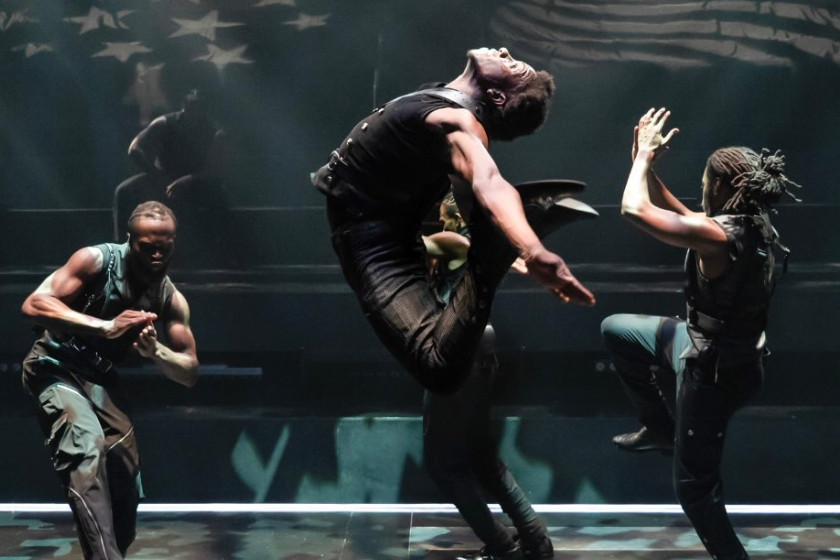
Photo credit: @teresacastracanephotography on Instagram
A Timeless American Story Told Through Movement
Celebrating the 250th anniversary of the United States, Arena Stage’s world premier production of The Fruits of our Labor dazzled, above all, in its striking portrayal of our nation’s history. Utilizing an awe-inspiring blend of dance styles, dress, and music, The Fruits of our Labor captured the American experience with mourning and hope in equal measure, coalescing in not only a moving showcase of the historical trials and triumphs faced by African Americans, but a performance that can speak to the downtrodden around the world. Somber yet celebratory, The Fruits of our Labor delivered an audiovisual feast to be enjoyed by all!
History/Background
Created in 2026, The Fruits of our Labor is a percussive, choreographic production by renowned dance company “Step Afrika!” Known for their extensive use of body percussion and the creation of complex rhythms without reliance on instruments, Step Afrika! brought this show alive at Arena stage through the efforts of artists Jakari Sherman, Conrad R. Kelly II, Vusi Mdoyi, and many more.
Conceived as a reflection on America just after its 250th anniversary, The Fruits of our Labor showcases the breadth of the American experience, and the diverse cultural factors that went into the production. Structured as a sequence of various musical motifs strung together, The Fruits of our Labor symbolically transports the audience through various culturally significant moments and periods of American history, utilizing strong historical imagery to build a show that makes one question the origins of our nation as a whole.
In short, as the title aptly suggests, The Fruits of our Labor analyzes the reality of America today, as well as the struggles and milestones that got us here.
The Performances
The most striking element of The Fruits of our Labor was, doubtlessly, the incredible choreography on display for much of the production, artfully crafted by the aforementioned Jakari Sherman, and Conrad R. Kelly II. Made up of just nine cast members, the show was split into various “acts,” or musical numbers. The creatives envisioned the show as an “album” more than anything, featuring various “tracks,” each incorporating nearly all cast members in some way. Keeping rhythm primarily through their bodies, the cast delivered effortlessly synchronized dance numbers, one after another, positively flowing in perfect tandem. Each member of the ensemble astonished as the production shifted from high intensity step/hip-hop inspired dance numbers to more mellow, slow-paced songs, all executed seamlessly, shifting into each other with purpose and fluidity.
Standouts included Joseph Vasquez, whose sharp movements and at times stoic characterization distinguished him as an almost antagonistic force in various numbers. Vasques at one point remained alone on stage near the end of one of the more impressive acts, utilizing a feathered pen and circular tablet to create unique, harsh rhythms as the lights faded on him, culminating in a chilling moment that evoked imagery of governmental corruption, and of the reversal of established norms. Jayden King and Ericka Still similarly astonished in their respective roles and boasted excellent technique across styles, from graceful and fluid ballet-inspired displays to sharp and almost militaristic movements.
Lastly, Agyei Keita Edwards, special guest artist and professional drummer, breathed distinct new life into the production with each appearance, breaking up sweeping choreographic numbers with drumming interludes that impressed in their jaw-dropping speed, as well as their almost tangible passionate center that bled into and supported the greater production.
The Technical Elements
Filling out an already incredible performance—that could ostensibly stand on its own—were the technical elements, which elevated the production to a truly immersive and striking work. Providing an expansive yet intimate environment for the ensemble to flourish, The Fruits of our Labor’s set design, passionately crafted by Colleen Doty, amazed in its stripped down simplicity and simultaneous attention to detail. Residing within a “thrust” oriented, four sided theatre (with the audience making up three of those sides), the set’s centerpiece was a wide staircase at the far end of the theater, allowing the ensemble to traverse down onto a square platform where the majority of the musical numbers took place. Most strikingly, however, was the strategically implemented usage of quotes from famous historical figures, namely Langston Hughes. Throughout various musical numbers, these quotes would appear along the edges of the stage itself, and twice on banner-like displays far above the stage, the powerful words complimenting each piece, and drawing greater significance to the movement and music on display.
What would all this hard work and meticulous planning be for, however, if you couldn’t see any of it?
Thankfully, the lighting design, by Yannick Godts, was operating at the same level as the rest of the production, not only illuminating the stage, but utilizing stark imagery and variation to add on to the story of The Fruits of our Labor. For much of the production, the stage was washed in a crisp white light, allowing for perfect visibility, and narrowing into thin beams to highlight certain performances, which added to the gravitas of certain numbers. Additionally powerful, however, was the purposeful use of darkness and overwhelming bursts of red and blue throughout emotional climaxes in the production to highlight moments of tragedy and oppression throughout American history.
Who is it for?
Boasting jaw-dropping choreography and a pressing message to boot, The Fruits of our Labors is a show to be enjoyed by all. Sharp and electric, it incorporates its audience tastefully throughout, contributing to a feeling of jubilation in the production’s joyful final act that leaves one aching for more.
The show runs a brisk 90 minutes, though it does so without intermission. It’s also mostly nonverbal, relying instead on movement and body percussion- an important fact to note depending on one’s preference.
As far as age goes, The Fruits of our Labor is appropriate across the spectrum, though the intensity of certain “numbers” within the show could perhaps startle those on the younger end of the aisle.
The Fruits of Our Labor runs at Arena Stage until November 1. Visit https://www.arenastage.org/ for tickets and more information.