
The Guy Who Didn’t Like Musicals
Wildwood Summer Theatre
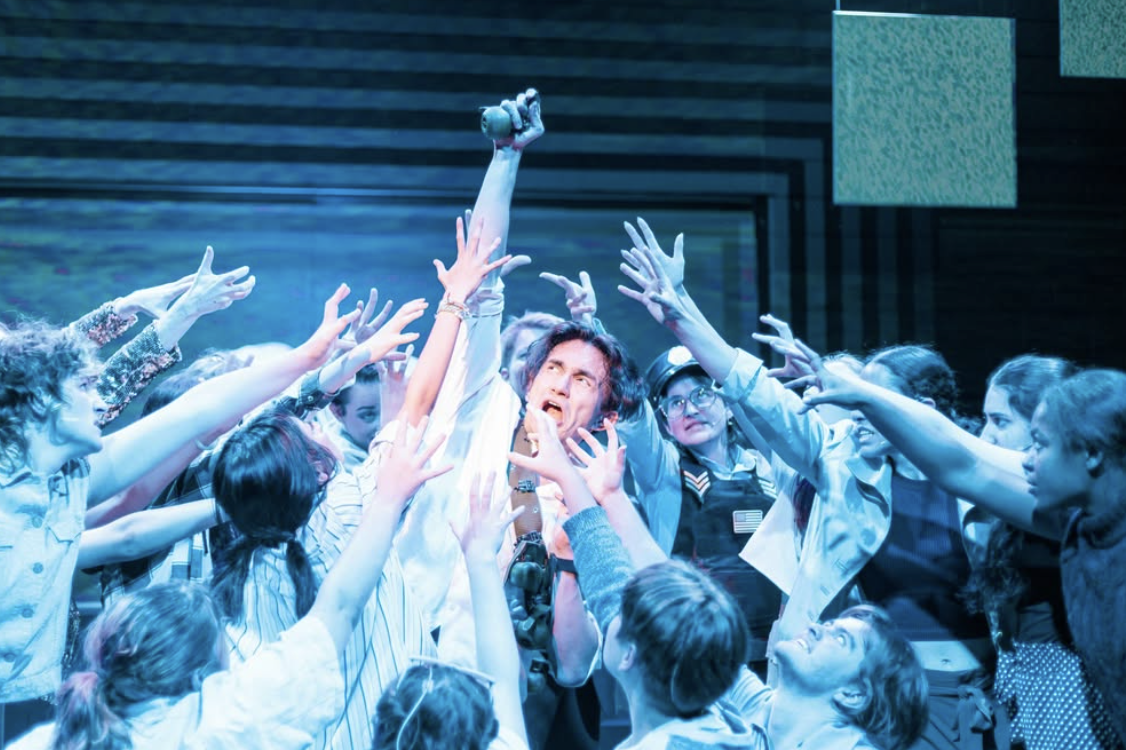
Photo credits: @morganes_photo on Instagram
It’s a sunny morning in the town of Hatchetfield, and the entire populace has broken into a showstopping musical number.
Song and dance fill the streets, with an invisible band accompanying the morning buzz. The citizens couldn’t be more joyous… well, all, except for one.
Paul Matthews hates musicals.
Though, I must admit: for a show about hating musicals, Wildwood Summer Theatre’s production of The Guy Who Didn’t Like Musicals was one heck of an entertaining one. Under Katie Quinn’s skillful direction, this zany cast and crew of ages 14-25 expertly embodied the eccentricity that makes StarKid so beloved.
What eccentricity, you might ask?
Look no further.
StarKid Productions
In 2009, a handful of University of Michigan students decided to write, direct, and stage A Very Potter Musical: their own parody show about the wizarding world. Hundreds of students crammed into the blackbox to watch the performance, not knowing the internet phenomenon it would soon become.
When StarKid uploaded their performance of A Very Potter Musical to YouTube for archival purposes, the video went viral--and so did the students! From then on, they wrote an entire Very Potter trilogy, as well as a slew of other musicals, all of which are available to watch on YouTube for free. They’re known for creating works that are witty, campy, spoof-y, and just the right amount of absurd.
Today, the company has become an internet sensation; they’ve staged their shows professionally, performed on tour, and have made many of their works available to license.
The Guy Who Didn’t Like Musicals is one of StarKid’s most popular works, kicking off their Hatchetfield saga (including Black Friday and Nerdy Prudes Must Die) with its release in 2018.
The morning after a meteor crashes down in Hatchetfield, the town’s citizens start singing and dancing like they’re in a musical. Die-hard musical haters Paul Matthews and Emma Perkins refuse to succumb to the insanity, so they decide to team up and investigate the cause… because, naturally, nothing could be worse than being forced to sing and dance in a musical. As it turns out, there’s forces at play more sinister than a catchy earworm.
In short, Hatchetfield basically becomes Schmigadoon on steroids. Like, a whole lotta steroids.
Wildwood Summer Theatre
I have to hand it to Wildwood Summer Theatre for being the DC metro area’s oldest entirely youth-run theatre! This means that every element of The Guy Who Didn’t Like Musicals was put on by actors and crew members aged 14-25, which is incredibly impressive considering the scope of the performances and tech elements they accomplished.
Go DMV teens!
Technical Elements
Performed in the intimate, black box space of Montgomery College’s Cultural Arts Center, The Guy Who Didn’t Like Musicals was the definition of an immersive, yet larger-than-life experience.
The set was sparse, consisting of a platform, a few hanging TV screens, and some wheeled-on set pieces. StarKid shows are truly meant to be performed in small, intimate spaces to achieve their full camp factor and comedic effect. Thus, Soph Meek’s set perfectly fit the style of the production.
Sean DiGiorgio’s projections were creatively utilized throughout: they displayed lyrics, faceless newscasters, or animations that accompanied the musical numbers being performed. The back wall of the black box also served as its own projection surface, covering the entire space in threatening warnings or transforming it into computer static.
Now, I’d like to make a special shoutout to conductors April Lopez and Dan Wilson, who completely expanded the show’s orchestration to fit a larger pit. While the score was originally written for a 4-piece band (drums, keyboard, guitar, and bass), Wildwood Summer Theatre boasted an incredible 11-piece orchestra (with the addition of woodwinds, brass, and cello). I personally loved the increased gravitas and intensity that the talented orchestra brought to Wildwood’s rendition!
Plus, it helped that audio engineer Beks Ryan wonderfully mixed the cast and pit throughout! It’s certainly an impressive feat that everything was balanced, considering the small space. Aaron S. Adams’s lighting also ramped up the show’s intensity by creating an edgy atmosphere in pivotal moments.
Of course, I have to give a final shoutout to the creative tech students behind the character Sam’s hairpiece. Without spoiling the show, the reveal certainly made me uncomfortable… and with the addition of Chris Yeung’s sound effects, I was squirming in my seat.
Performances
Naturally, we have to begin with “the star of the show” himself: Paul Matthews, brought to life by Tudor Rico. Rico’s initial robotic expression certainly embodied that of the everyday businessman, and reflected Paul’s tendency to traverse life like a videogame NPC. As the story progressed and Paul became more connected with his own feelings and desires, Rico transformed into a resolute hero… until his crazed rendition of “Let It Out,” in which Paul’s inner demons scarily came to light.
His counterpart, Emma Perkins, was expertly realized by Aisley Wallace Harper. Harper’s dry, grounded performance stood in perfect contrast to her coworkers--Ollie Clark and Keri Anderson’s bubbly Nora and Zoey--which brought a refreshing sense of reality to the chaos in Hatchetfield. Her one-liners were expertly timed, and her expression was delightfully deadpan; in “Cup of Roasted Coffee,” Harper half-heartedly executed steps alongside Clark and Anderson’s exuberant cartwheels, splits, and flag-tosses.
Meanwhile, Noah Anthony Haren I was a personal standout as the kooky Professor Hidgens. With the bow-legged stride of a cartoon character and eccentric accent to match, Haren had the audience in fits from his first gleeful prance across the stage. When he wasn’t petting his Amazon Alexa like a villain stroking his housecat, he was donning a sparkly jacket and belting out his self-written musical about the good ‘ol college days. He could’ve easily stepped out of Phineas and Ferb, which is the highest compliment I could bestow on anyone.
Rounding out the principal cast were Nora Rudmann’s eager-to-please, anxiety-ridden Charlotte; Aaron Patrin’s buggy-eyed, sleazeball Ted; and Sophia Braier’s stressed, kind-hearted Bill. This group of oddballs made for a slew of entertaining moments, and rapid-fire banter that kept the audience on the edges of their seats.
Of course, the ensemble presented the perfect opening impression to this production: boundless enthusiasm, energetic vocals, and heaps of character. From the moment they popped out from behind the platform and strutted across the stage brandishing jazz hands, it was immediately clear what type of campy, theatrical production the audience had just walked into. They kept this energy sky-high all throughout, whether they were delightfully swing-dancing or menacingly jerking around like zombies.
Who is it for?
The Guy Who Didn’t Like Musicals is for anyone who might think a healthy dose of campiness is key to a great time. It’s funny, dark, outlandish, and wildly entertaining. I had no idea what was going to happen next at any given moment--it subverts your expectations, and the cast and crew does an excellent job leaning into this rollercoaster ride of a production.
This is definitely a show that I’d consider PG-13, or recommended to ages 13 and up. The playbill’s content warnings for the show include: physical violence, strong mature language/sexual themes, gore, body horror, and the use of prop guns and weapons. It also advises of loud noises and strobing effects/haze. Again, while the show is decently dark, it’s all played up for camp.
Attention DMV theaters: let this be a sign to produce more StarKid productions! This is the first I’ve seen, and now I’m hooked, so I need to see the rest.
The Guy Who Didn’t Like Musicals runs for one more weekend of shows, so be sure to visit wst.org for tickets and more information.