
Westfield High School
Teen reviewer: S. Bowles
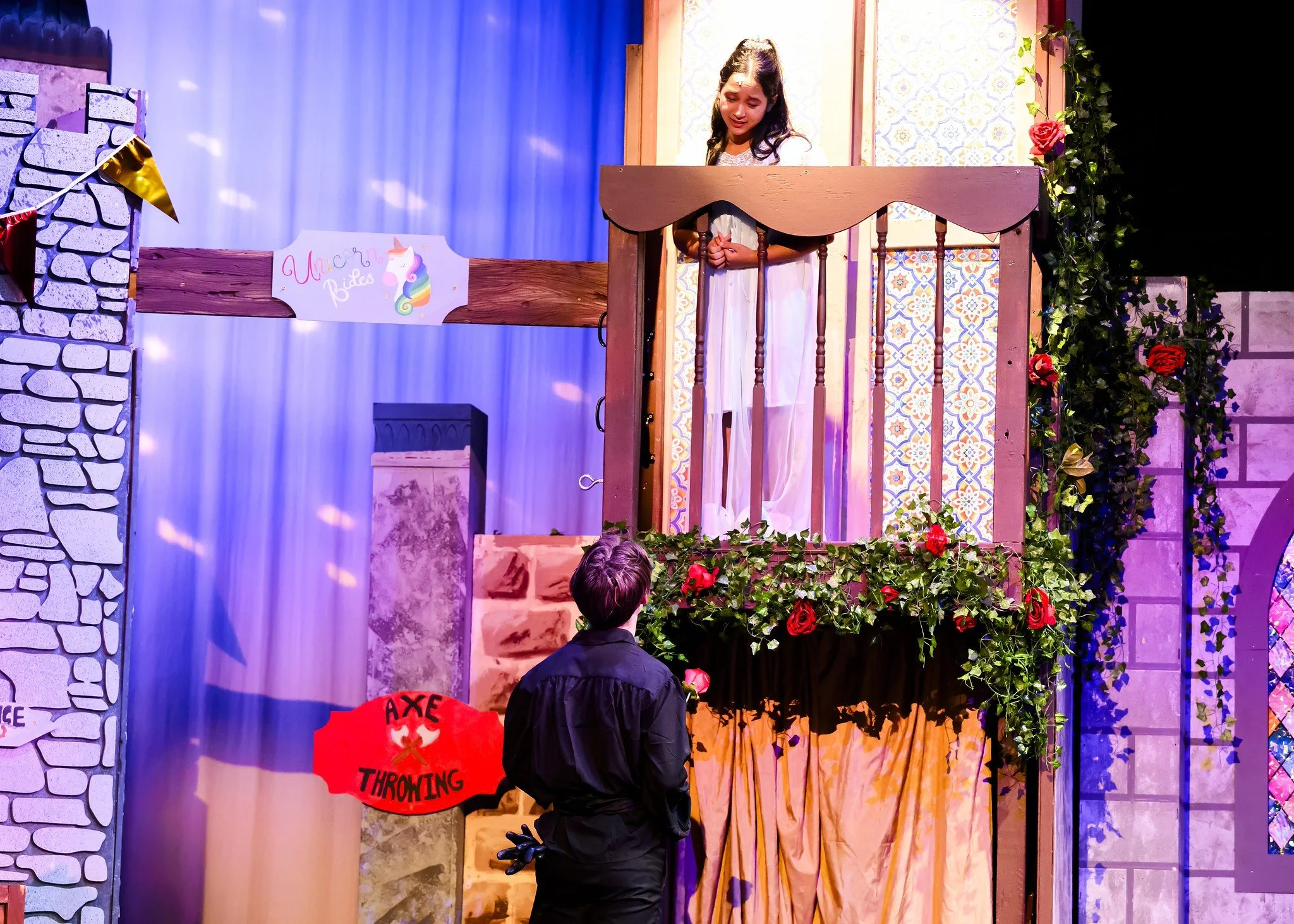
Photo credit: Mike Beaty
Never was a story of more woe than this of Juliet and her Romeo…
But in this iteration of the timeless story, there was vibrancy brought to every scene. Westfield High School’s production of Romeo and Juliet had a unique take on the play, bringing color, light, and fun to the tragic story, and displaying the joy within the lives behind the tale.
Now, faster than Romeo moved on from Rosalind, onto the rest of the review!
Romeo & Juliet
Most everyone knows one thing about this classic: they both die at the end. That is an ever-present part of the story, and that ending is what every piece of the plot is building up to. However, there’s more to the story than the conclusion.
This Shakespeare play takes place in Verona, Italy, where two families, the Montagues and the Capulets, are in a ceaseless struggle for power. The families hate each other: as they do, as they plan to do, and as they always have. But when Romeo, a newly heartbroken Montague, and Juliet, a soon-to-be betrothed Capulet, meet, something changes. What ensues is a series of romantic and tragic events that set the bar for all star-crossed lovers to come: arranged marriage, unforeseen circumstances, and six sequential deaths.
Well, while there have been approximately ten billion (as a guesstimate) productions of this play, this one took a fascinating new route.
This production
Even just walking into Westfield High School, you were already taken into the world of Verona; the lobby and hallway were set up like a Renaissance fair. That is, a fair…taking place in the Renaissance. It helped set the mood for the jubilance of Act 1, and kept the audience in the same world during intermission.
The stage was set up with shorter buildings on either side of a tall tower, which Prince Escalus often used to address a crowd. Romeo and the Montagues often congregated on house left, while Juliet’s balcony and other Capulet scenes were set on house right. In between, though, was where everything mixed and moved together. During a brawl or a ball, the actors would weave their patterns across the stage. Sometimes, interactions were clearly initiated, but in even more cases, there was tension built in the background. This background action, especially, was a commendable directorial choice by Christine Maxted, who made sure to keep the tension between the families ever-present.
One notable aspect of this show was the impeccable costuming. Of course, there was the classic rivalry set up through the colors–Capulets, blue; Montagues, red–but there was so much more thought put into their work! From pieces that looked like they were taken straight out of Shakespeare’s time to entirely modern outfits, every costume in this show was chosen with care, and that came through in each and every actor onstage. A personal favorite costuming choice of mine was Romeo’s arc: He began the show in brooding tones, started to change into more colorful historical wear, and ended in an outfit that could’ve been worn today. This arc demonstrated his evolution from an initial air of melodrama, to eventual sincerity, and then, in exile, to utter desperation.
Speaking of Romeo and Juliet, were these actors killer! Ah…poor word choice. In this performance, Romeo was played by Riley Burden, and Juliet by Langlen Heisnam. These two each worked their distinct acting styles into the characters, which, while different, didn’t clash. Burden played deeply into Romeo’s melodrama, becoming the pouty teen heartthrob–-complete with a mix of childish physical comedy and determined yearning. Heisnam was the perfect ingénue; she was giddy, youthful, and dreamy. She didn’t play Juliet as a maliciously rebellious teen, she portrayed Juliet as earnest and in love. Together, their heightened performances made a lovely picture of true, blue, puppy love.
The Nurse (played by Iris Cooper) brought on many a laugh; Cooper truly brought her all to this part! Transforming into the older woman, she brought comedic bits to every scene. And though her funny, brash performance made quite an impression, Cooper worked beyond that to give the Nurse depth and care. Her anguish after Tybalt’s death made many wonder if Romeo was so right after all, and her wails in Juliet’s “death” scene were truly haunting. Another great parental figure, Kiera McCrea’s Friar Laurence served as Romeo’s guide, chastising and stern, but still very loving. The fear in her eyes at Friar John’s mistake and Romeo’s fatal exploits reminded the audience of his humanity. McCrea’s groundedness in the role made her performance memorable–we didn’t just see Friar Laurence as this all-knowing elder, but as someone simply trying his best to help a younger man succeed in life and love.
As previously mentioned, the dedicated ensemble made sure there was always something going on in the background. Whether they were merchants peddling their wares, warring members of the two households, or guests at the masquerade ball, they consistently added to the comedy and made every scene more interesting. A couple of moments were especially hilarious: there was an entirely cartoonish chase at the beginning of the play, and a merry conga line during the ball, where the cast was decked out in modern Halloween costumes. Overall, this ensemble was always a joy to see, and they added something to every scene.
Still, we can’t forget the true stars of the show: the puppets. This production began with a cart and a curtain. That wasn’t all, of course–two hand puppets (maneuvered by Karli Powell and Natalie Talberg) popped up and gave the iconic opening monologue to the audience, to applause and laughter all around. And on the Friday night show, there were two ASL interpreters situated right in front of the stage on the left, who interpreted the entire show. This was a wonderful addition, and I often found myself switching between their sign and the actors on stage, drawn to each of the riveting performances.
While I saw one version of this show, the Romeos and the Juliets were double cast, and because of that, there were two amazing possibilities for the way this show was played. A big shoutout to Phineas Younce, playing Romeo, and Madison Hummer, playing Juliet!
Finally, before the end, a quick commendation of this show’s direction: it excelled because it didn’t take itself too seriously. Importantly, though, it wasn’t simply juvenile–it still handled death and pain with gravity. The choice to include brevity and comedy in the show simply added depth to the tragedy. In a way, the comedy made the ending all the more heartbreaking. The people were just people, with joy and love in their lives. That was what made this direction so subtly brilliant.
Who is it for?
This show is for theatre lovers, theatre goers, and even those who don’t often find themselves enjoying theatre all that much. It was fun, colorful, and notably, accessible. It stayed loyal to Shakespeare’s original text, but its presentation was bright and playful enough that even those who normally find Shakespeare too snobbish and confusing would enjoy it.
As many of Shakespeare’s plays tend towards, it was a longer show, running around 3 hours and 30 minutes (including a 15 minute intermission). For the most part, it didn’t drag on, but because of the hefty material, it simply had a lot to get through.
This show included plenty of death and a good bit of romance, but it never got very adult. The most mature the show got was some impassioned kissing and a few bloodless stabbings. This show is famously a tragedy, but with this particular direction, even audience members as young as 8 could see it. And, since it was very well done, this show could reach any age range, young or old.
This production has since closed, but you can find information on Westfield High School’s future productions at https://www.westfieldtheatre.com/.